
1. Trust Falls
What truly sustains a brand when identity is suspended

Businesses constantly navigate transitions from scaling startups to corporate mergers, digital transformations to leadership changes. During these critical periods, organisations exist in what could be called the "liminal space" a time where identity is suspended and trust becomes both vulnerable and revealing.
What truly sustains?

Remember trust falls? That activity where you close your eyes, cross your arms, and fall backward, trusting someone will catch you. The moment of release reveals everything, whether trust was real or imagined, whether the relationship could bear actual weight.
Organisations experience their own version of trust falls during major transitions. The moment when established structures no longer hold, when familiar patterns dissolve, when what was promised meets what actually exists.
The Liminal Space
The territory between states is revealing, especially when an organisation’s identity is held in suspension.
That uncertain period between a merger or growth phase and the tangible steps toward combining or future operations. The transitional phase when an established business experiments with AI while its decision frameworks remain traditionally human-centered. The formative phase when a startup outgrows its founding story but hasn't yet found a new one.
These are not ordinary shifts. They open a void where identity exists in two states simultaneously. Where trust becomes both most vulnerable and revealing, exposing the difference between what an organisation says about itself and what it consistently does.
Companies don't exist as abstract entities. They are living ecosystems of human interaction, meaning-making, and relationship. During liminal periods, this human reality becomes both more apparent and more consequential.
In these spaces, values become visible under pressure. What a company truly values beyond stated principles becomes evident in what it protects, prioritises, and permits. Identity becomes actively negotiated rather than passively accepted. The narrative of "who we are" is visibly contested, with different stakeholders advancing competing interpretations.
Trust Under Pressure
Here's what makes liminal space particularly treacherous for organisations. They spend years building trust through consistent delivery, reliable behaviour, authentic relationships. Then transition arrives, and suddenly all that accumulated trust capital becomes vulnerable to a single moment of misalignment.
The challenge isn't just managing change, it's protecting years of trust-building from being undone by weeks of inconsistent execution.
In liminal moments, what endures isn’t the new strategy but the foundations already lived.
The original story.
The accumulated brand equity.
The established customer relationships.
The embedded culture.
The legacy of kept promises.
The behaviours and values that consistently manifested before change began.
These foundational elements -
The human connections
The organisational culture
The earned trust
All become most visible when everything else is in flux.
What Gets Revealed When Everything Shifts
Years of observing businesses large and small through these in-between moments reveals what transitions actually do. They expose gaps that were always present but hidden during stability.
When familiar structures no longer provide cover the disconnects become impossible to ignore. What emerges isn't necessarily what's strongest but what becomes most visible under pressure.
In every context from start ups, mergers, tech updates and evolution and high growth phases, the same patterns occur.
Leaders unveil sleek new brand architectures with confident proclamations of synergy. Meanwhile, beneath this carefully constructed narrative, an undercurrent begins to dominate. In an early-stage company it may be the imprint of a founder or early team. In a merger it may be the incumbent culture, or the acquired company’s ways of working that prove more effective and rise upward.
This creates what might be called the shadow organisation chart - the real map of how decisions get made which differs from the official structure presented to stakeholders. Visible only in how decisions actually get made. Which clients receive priority. What behaviours still earn nods of approval. It reveals which company's way of working actually wins, or whose influence - founder, investor, original team - truly sets the course.
During digital evolution projects businesses invest millions in interfaces that promise frictionless experiences. Yet customers quickly sense the dissonance when these modern facades connect to legacy systems.
The gap between the marketed experience and the delivered reality becomes a trust liability no amount of design can bridge.
And in those promising startups. Founders brilliantly articulate their product capabilities yet suddenly struggle when asked a seemingly simple question. "What do you stand for beyond the solution itself?"
What's most obvious is that during periods of change what gets exposed isn't what businesses declare about themselves. It's the difference between what they say and what they consistently do when no one seems to be watching.
Trust forms not through announcements but through small accumulated moments of alignment between what's promised and what's experienced.
What Holds When Everything Falls
These observations suggest a different way of understanding what actually holds businesses steady during liminal moments.
Living systems of human interaction reveal themselves most clearly when frameworks that previously governed trust relationships are themselves in flux.
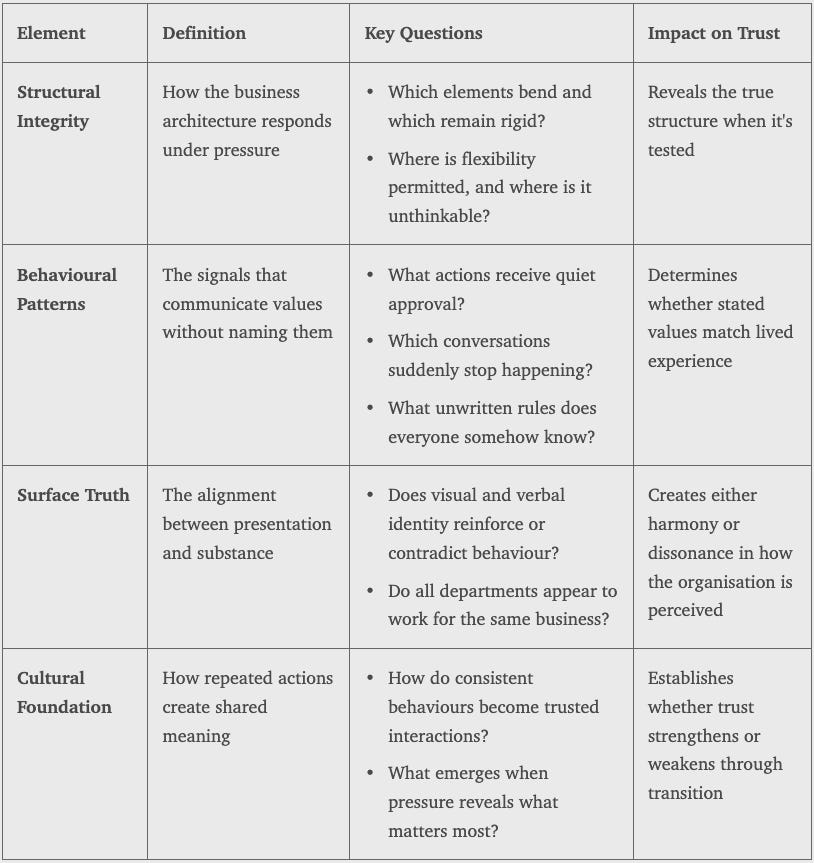
Four elements determine whether trust breaks or holds.
Structural Integrity
Declarations about empowerment, autonomy, or flat culture only hold if the future org design evidences it. In a merger, leaders may promise local decision rights yet procurement and budgets are immediately centralised. In scaling, founders may praise a flat culture although they quietly add layers of hierarchy. In reorgs, executives may speak of empowerment while new approval gates slow decisions. These moments expose the load-bearing beams of the business. Trust fractures when the promised structure collapses under pressure. Trust deepens when the architecture proves sound.
Behavioural Patterns
Behaviour shows the real rules of an organisation. A company may trumpet collaboration as a value, yet real influence accrues to those who act as gatekeepers of knowledge and relationships. Another may preach innovation, yet punish every failed experiment. Over time, people learn what actually secures advancement and protection. These hidden codes shape trust more powerfully than any published values. When behaviours align with declared values, trust strengthens. When the gap widens, cynicism takes hold.
Surface Truth
Brands polish their exteriors. A bank may launch a sleek new app with instant transactions, yet the moment a customer applies for a loan they are pulled back into weeks of legacy paperwork and approvals. A retailer may advertise effortless returns, yet customers face confusing rules the moment they try. A technology company may promote seamless integration, yet its support channels remain fractured and unresponsive. Each gap between polished promise and lived experience creates a trust liability no amount of design can disguise. Trust fractures when the surface masks decay. Trust deepens when delivery and promise align.
Cultural Foundation
What repeats becomes culture. In a growth company, daily standups provided rhythm and alignment. When leadership abruptly replaces them with irregular updates, disconnection grows and trust slips. In a large organisation, long-running weekly news updates outlasted multiple restructures, offering continuity when everything else felt uncertain. Rituals act as anchors in liminal moments. Trust fractures when they are stripped away. Trust deepens when they endure.
Businesses that recognise and nurture these elements don't merely survive transitions. They emerge stronger, with deeper trust relationships and clearer identity.
The liminal space between states isn't merely something to endure. It's a strategic opportunity to reveal and reinforce what truly matters.
What's revealing is how these patterns manifest in an organisation's brand. Not merely as visual identity or positioning statements, but as the lived experience that emerges when promise meets reality.
In liminal moments, brands cannot hide behind carefully crafted exteriors. The gap between articulated identity and actual behaviour becomes immediately apparent, creating either profound trust or lasting dissonance that persists long after the transition ends.
The Curious Persistence of Trust
Patterns of trust echo across contexts, even as trust mechanisms evolve.
From handshakes to digital signatures. From face-to-face meetings to virtual experiences. From hologram keynotes to whatever comes next. Certain foundations remain stubbornly consistent.
Evidence still points to human values and intentions.
Expectations still centre on reliability and consistency.
Demands still focus on transparency and accountability.
Responses still depend on genuine community and relationships.
The medium evolves but the message endures. Trust ultimately forms through consistent values, transparent actions, and genuine connections.
Finding Balance in the Between
During periods of significant change, success doesn't come from clinging desperately to yesterday's identity or leaping blindly toward tomorrows.
It emerges from noticing what naturally holds even as everything shifts around it. From identifying the consistent behaviours that build trust precisely when certainty is lowest.
The evidence suggests that what catches businesses during trust falls isn't safety nets designed for that purpose. It's the integrity of what was already present. Revealed more clearly precisely because of the fall.
This raises an essential question for any business in transition.
What elements would hold if everything else fell away?
What would remain when scaling across markets?
What would remain if the carefully constructed narratives suddenly disappeared or no longer fit?
Those elements, whatever they may be, are worth noticing. They might be exactly what catches a business during its next leap. And in the space between what was and what will be, they reveal the enduring foundations of trust that transcend any single state of being.
Not to define. Just to notice.
This idea plays out differently when mapped onto decentralised systems. For the Web3 take, see how the theme unfolds in the Paragraph edition itsliminal.xyz/trust falls